Drought Restrictions and Smart Irrigation: How to Stay Compliant and Keep Your Lawn Healthy
A notice in the mail, a stage change on the local utility's website, a "no watering" sign on a neighbor's lawn — drought restrictions can land on a yard without much warning. The rules can feel sudden and specific. But across most U.S. municipalities, drought restrictions watering rules follow a small handful of patterns.
What drought restrictions actually look like
Local rules vary, but the structure rarely does. Most drought restrictions watering rules combine some version of these five categories:
| Rule type | What it means | Common form |
|---|---|---|
| Day-of-week limits | Watering allowed only on certain days | Odd / even house numbers; specific weekdays |
| Time-of-day bans | No watering during peak heat | Often 10 a.m. – 6 p.m. (varies by jurisdiction) |
| Stage-based escalation | Restrictions tighten as conditions worsen | Stage 1 voluntary → Stage 4 emergency ban |
| Runtime caps | Maximum minutes per zone or day | Often 30 min/zone, 2 days/week |
| Equipment rules | Specific hardware required | Rain sensors mandatory; drip preferred for beds |
The specific numbers vary widely. The categories almost don't.
Which lawns feel restrictions hardest
Established lawns can usually weather most restriction stages on schedule adjustments alone. The yards that struggle tend to fall into a few categories: new sod still rooting in, freshly planted trees and shrubs, garden beds without drip, and lawns with chronic coverage problems that already need extra runtime to compensate.
Most jurisdictions recognize these edge cases. Variances are common — 30 to 60 days for new sod, ongoing exemptions for drip irrigation, and equipment-based variances for WaterSense-certified controllers. The homeowner has to apply, but the paperwork is short. Without it, the standard rules apply and the most vulnerable parts of the yard suffer first.
How the common rule patterns map to smart irrigation
Each category of rule has a counterpart in how a modern irrigation system runs day to day:
Day-of-week limits. A smart controller can be set to run only on permitted days, including odd/even rotations, with no manual override required.
Time-of-day bans. Most smart systems default to a 4–8 a.m. window, well before the typical 10 a.m. cutoff in restricted areas.
Stage-based escalation. Weather-aware controllers reduce runtime automatically as conditions warrant. Some can be set to a specific drought stage that adjusts every zone in proportion.
Runtime caps. Per-zone runtime control means a system can hit a cap precisely, rather than rough-cutting an entire schedule.
Equipment rules. A WaterSense-labeled controller or rain sensor often satisfies the requirement directly — and in some jurisdictions, it qualifies the homeowner for a variance. The EPA's WaterSense program maintains a registry of certified equipment that utilities increasingly reference when granting exemptions.
Practical compliance steps
On any lawn, working through the local drought restrictions watering rules comes down to a few steps.
Find the local utility's water page. Most municipal providers publish current rules and stage status. Save the link.
Look for new-sod variances. A 30–60 day variance is common, but it almost always requires an application.
Set the controller to comply, not over-water. Morning-only runs, deep and infrequent, with rain skips on.
Walk the yard once a week. Coverage problems multiply under restrictions, because overwatering one zone to keep another green stops being an option.
Update the schedule when the stage changes. A move from Stage 1 to Stage 2 usually means a day-of-week reduction, and the schedule needs to follow.
How smart irrigation changes the math
Drought restrictions watering rules are easier to live with when the system underneath isn't fighting them. Traditional sprinklers depend on overlap between fixed-arc heads; when one zone goes dry, the fix is more runtime — the first thing a restriction takes away.
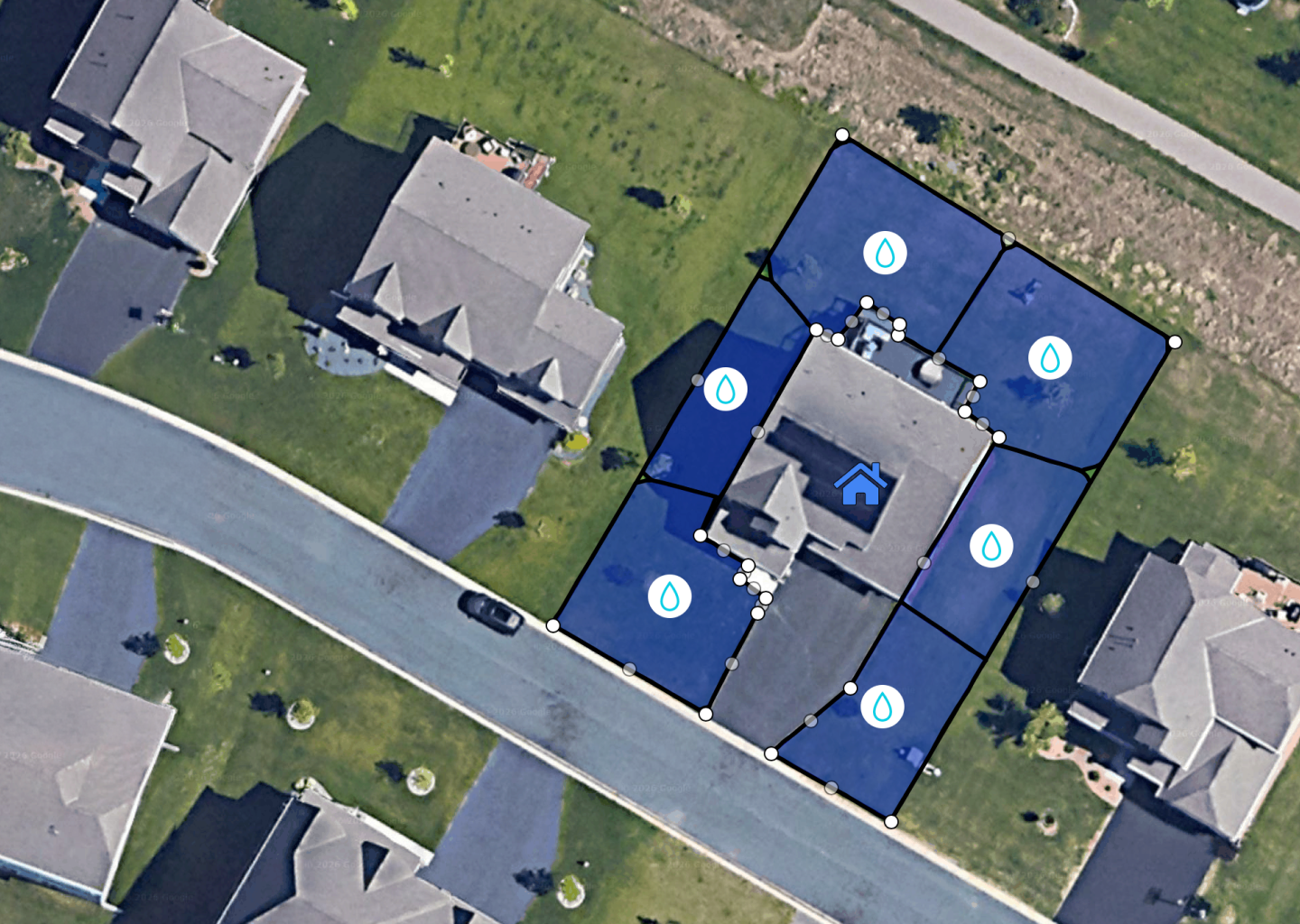
Precision systems like Irrigreen map each head to the actual shape of the lawn, so coverage is even from the start and runtime doesn't need to compensate. For homeowners upgrading an aging system, the cleanest path is one that meets common equipment standards and runs morning-only schedules by default — compliant before the next stage change hits.
DIY vs certified installer
DIY. A weekend install is realistic on smaller lots where an existing system is being retired or where work can be scheduled around restriction windows. The app walks through mapping, head testing, and an initial compliant schedule.
Certified installer. The default path for larger yards, irregular grades, or anyone coordinating around new landscaping or restriction-sensitive timing. A certified installer can apply for variances on the homeowner's behalf and verify the system meets local equipment requirements at handoff.
FAQs
Where do I find my local drought restrictions watering rules? The local water utility's website is the most reliable source. Many utilities also send updates by email or text when a stage changes. Irrigreen's setup uses region and zip code to anchor the initial schedule.
Will a smart sprinkler system qualify me for a variance? Sometimes. A WaterSense-labeled controller or precision-coverage system qualifies in some jurisdictions. Irrigreen's documentation and per-zone reporting speed up applications, but the decision sits with the local utility.
Can I still water new sod under restrictions? Usually yes, through a new-sod variance — typically 30 to 60 days from install. The homeowner applies; the install receipt is usually enough documentation.
What happens if I miss a restriction stage change? Most utilities issue warnings before fines. A weather-aware system like Irrigreen adjusts automatically as conditions tighten, so the schedule isn't running a Stage 1 plan in Stage 3 conditions.
Are sprinklers banned outright in severe drought? In extreme stages — Stage 4 or emergency — sometimes yes, with drip and hand-watering still allowed. Irrigreen's Smart Drip system keeps beds and trees alive during full sprinkler bans.
Do drought restrictions apply to drip irrigation? Drip is usually treated more leniently because it uses far less water and loses little to evaporation. Many municipalities exempt drip from day-of-week rules entirely.
Will the system tell me if my schedule violates a restriction? Some systems will warn, but the homeowner is responsible for matching the controller schedule to current local rules. Irrigreen's app makes the active schedule visible at a glance for quick audits.
A practical next step
For any yard in a region where drought restrictions watering rules are common, build the schedule around them from the start rather than retrofit later. Start a design with the YardTrace™️ Tool to map coverage to the lot and set a schedule that's already compliant out of the box.
TL;DR
- Most local drought rules follow a small set of patterns: limited days, banned hours, stage-based escalation, runtime caps, and equipment requirements.
- The specific numbers vary widely by jurisdiction; the categories almost don't.
- Variances exist for new sod, drip irrigation, and certified smart equipment, but the homeowner usually has to apply.
- Smart irrigation handles the common rule patterns automatically: morning-only schedules, weather-based skipping, and per-zone runtime control.
- Compliance is usually about hardware, not effort — once a system is set up right, the rules take care of themselves.